Students are curious:
I want to get serious about programming. Which language should I choose?
If you’re going to get serious, then any of them.
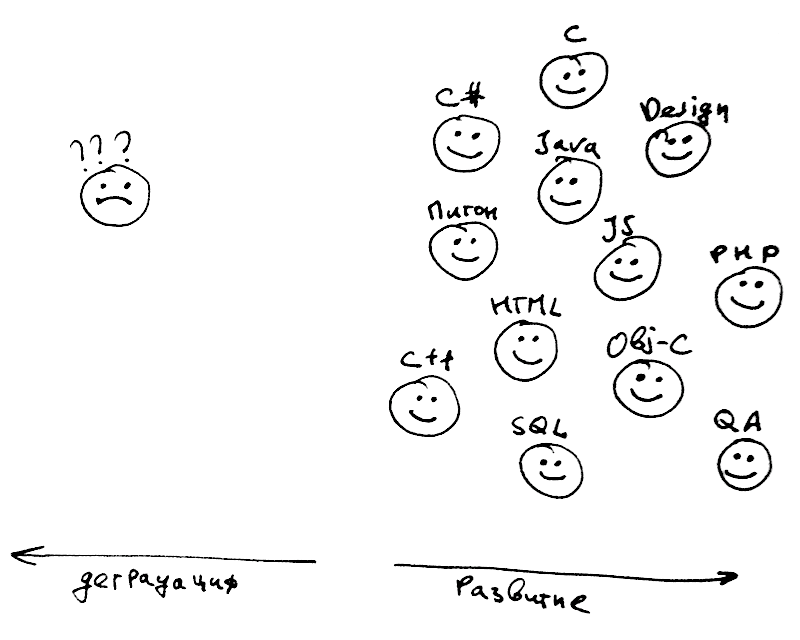
A common mistake among students is to sit around and do nothing. We won’t discuss laziness here; instead, let’s look at the situation where a student is paralyzed by the choice of a language or technology.
From outside the profession, some people think there are languages (technologies, libraries, frameworks) whose study is guaranteed to lead to success, and others whose study will be nothing but a waste of time. And if that’s the case, the student has trouble choosing: what if I make the wrong choice and it’s all for nothing? But the secret here is very simple: studying any language leads to success.
While some students waste time in unproductive, superficial musings about the advantages and disadvantages of one technology or another, other students read books, write programs, make mistakes the hard way, rewrite programs from scratch, and already know firsthand things the first group doesn’t even suspect.
It’s also important to understand that choosing a language is, in most cases, just choosing the syntax for entering instructions into a computer. The fundamental principles of building systems, the principles of object-oriented or functional programming, algorithms, protocols, and standards are the same everywhere. From an OOP point of view, a class interface in Python will be the same as in C#. The format of a JSON response from a server for Android is no different from a JSON response from a server for iPhone. And so on.
Choosing the first language to study seriously is not a choice for life. Most likely, the student will learn several more programming languages before defending the thesis, and then several more after becoming a professional. And so on for the rest of their life.
And so, while some guys are learning and developing, other guys are wasting time on doubts.
Go and program!
In previous installments:
— Students Are Curious about defending a thesis.
Interested in my opinion on any question of university life? Send your questions to volodymyr.obrizan@gmail.com. Anonymity is guaranteed. Answers will be published as questions come in. Questions can also be asked through the anonymous-questions site http://ask.fm/obrizan