The other day I saw a link to an amusing Flash thing: http://megaswf.com/serve/102223/ It gives a clear demonstration of the essence of genetic (evolutionary) algorithms.
The idea is simple. You need to make a bicycle so it travels as far as possible. The computer knows nothing about what a bicycle is supposed to be like. It gets fed various bizarre shapes at random. Among the parameters: body size, wheel size, distance between the wheels, shock absorber position. Maybe they’re something else, but judging by the logic of it, something along those lines.
In the early generations the bicycles come out as a total train wreck. The first generation shows a sample of 20 random bicycles. For example, these:
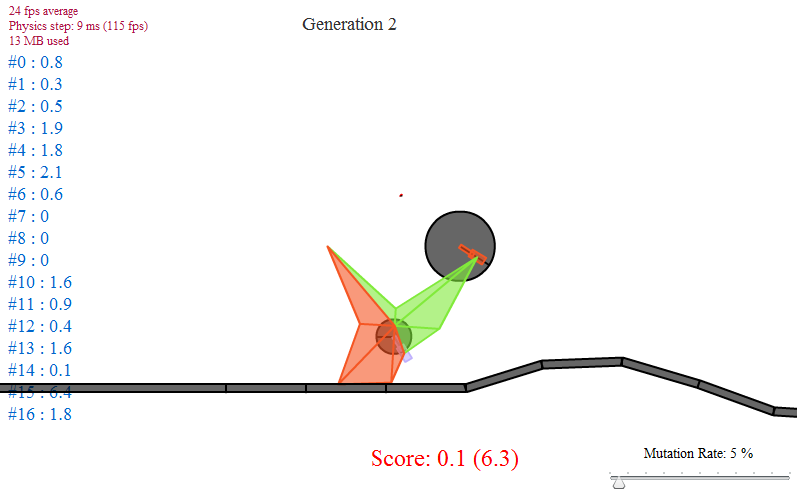
On the left, in the column, you can see experiments with the latest newborn freak, namely: how many notional meters of track it traveled. The most interesting part starts when the generation changes. At that point the very worst ones (the ones that traveled the least) are discarded (“This is Sparta!!!”), and the best prototypes are “crossed,” i.e., they exchange some parameters, for example the body shape or the wheel diameter.
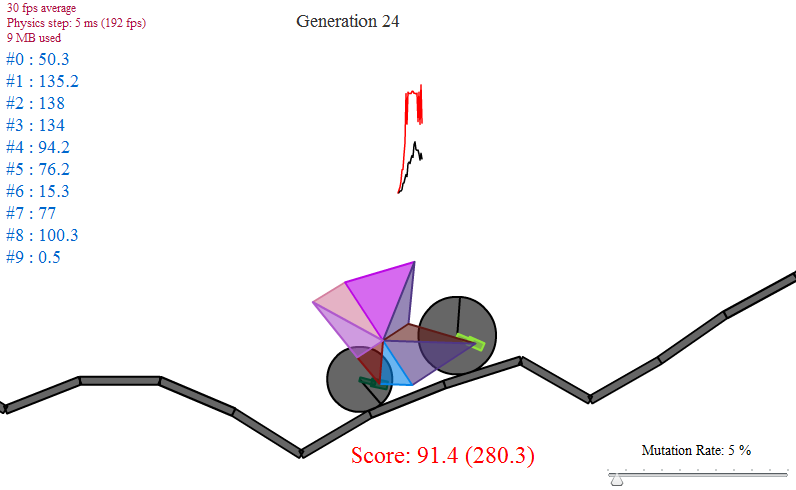
Some interesting variants turn up:
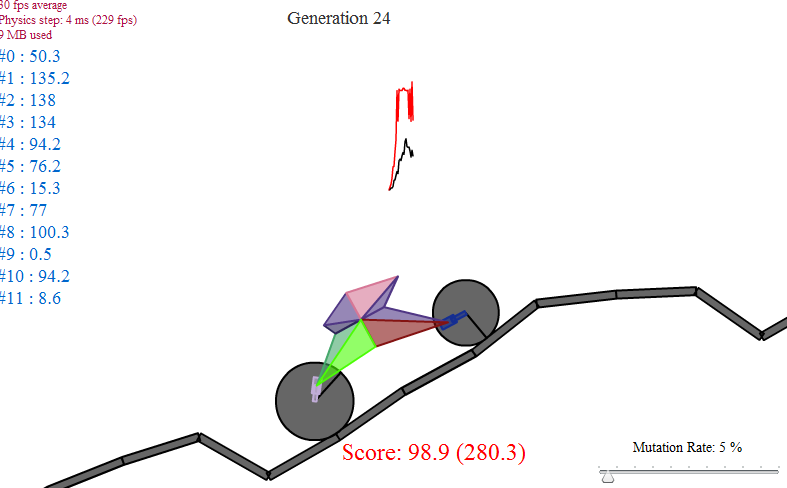
Or here’s an example of a bicycle that looks a lot like a motorcycle:
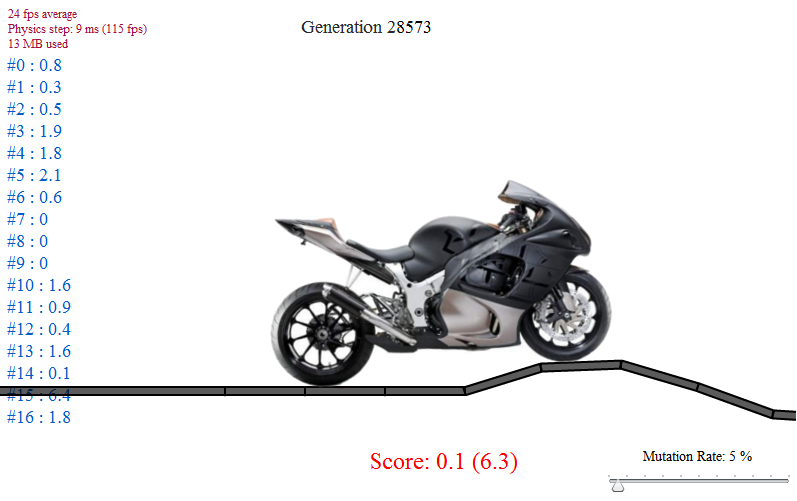
But if you wait, as I did, about nine hours, you may end up with a perfectly usable vehicle:
Conclusion (every lab report, term paper, thesis, or dissertation has to have a conclusion): genetic algorithms are widely used in many problems of the national and agricultural economy.