People used to say that movies would kill theater. Then they said television would kill movies. Then they said the internet would kill television, movies, theater, books, magazines, radio. But for now, somehow, they all live together. The internet did not become a replacement for the things mentioned. It became the medium through which all of it can be delivered to consumers.
It has already been said that the internet not only lets you make samizdat available to everyone, but also shortens the delivery cycle. You can read news in blogs, download e-books, listen to internet radio, watch television over the internet. Nevertheless, the internet has not solved the problem of content and its quality. Let’s say more: the internet has made this problem worse. To write and publish a book, you have to spend a lot of money, effort, and time. No one would do all that for the sake of yet another turd. Samizdat on the internet developed along this path: personal site → blog → Twitter. Each transition made publishing simpler. The cost of a Twitter post is zero. All this simplicity, convenience, and free-of-chargeness has produced a great deal of motley content, or simply informational garbage.
Unabomber writes that on the internet you can do three things: consume information, process information, produce new information. All the time spent on the internet is the sum of the three activities mentioned. And every additional blog added to an RSS reader, or every new link received through Twitter or ICQ, loads up the first activity: consuming content. Thereby crowding out of life actions related to processing information and producing new information.
All right, since the post is called “On the Design of Online Magazines,” let’s get closer to design. Today, in yet another specialized mailing list, I received a batch of articles about electronics. Only one interested me: “Do we need an international EDA roadmap?”. We won’t get into the substance of the article; we’ll go straight to the formatting.
Because the column is narrow, the images have to be squeezed down. Because the images are small, the phrases are very hard to read. There is no “Enlarge” button. The pictures are not clickable. It is also sad to see graphs compressed in JPEG format. Try, for example, to read what is written in the red oval.
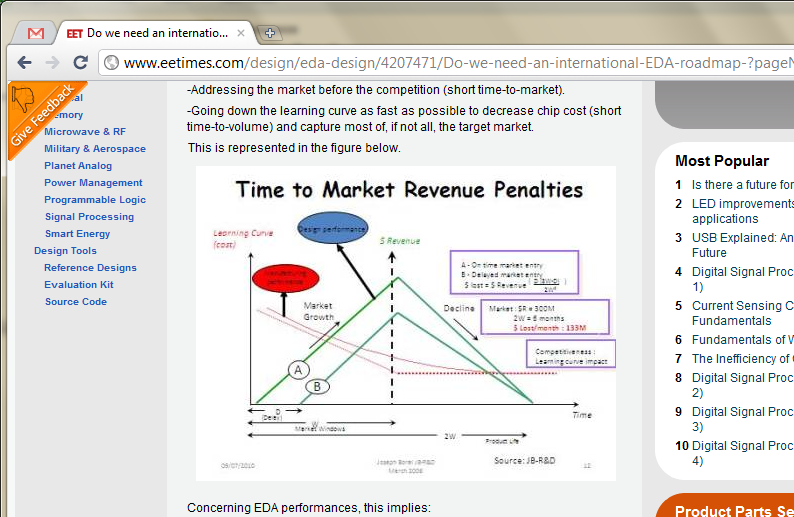
Or here is a more serious case (you can see Microsoft Word’s ears sticking out from behind the table):
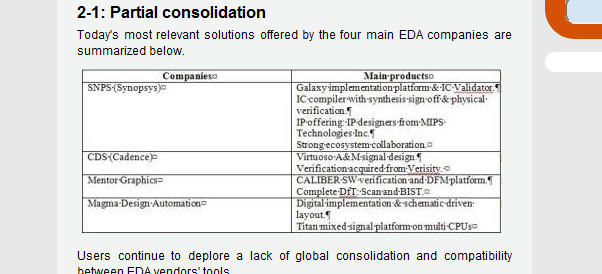
You can look through the entire image folder. http://www.eetimes.com/ContentEETimes/ Out of more than 500 images, only 12 are in PNG format.
Another design move that irritates me is page numbering. I don’t think this is done for the reader’s convenience or to save their traffic (everyone has broadband access now). It is done for two reasons: a) to generate more ad impressions; b) to assess the depth of the reader’s interest in one topic or another (the farther they clicked, the more interesting it is).
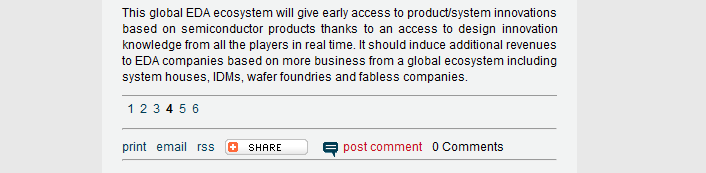
With the appearance of the World Wide Web, the concept of a “page” changed. Now it is not something rectangular, limited in area, but effectively unlimited space for placing information. If before, division into pages was dictated by the amount of information (the page ran out of room — start a new one), now it happens by units of information: post, article, topic (the post ended — start a new page).
Undoubtedly, over time design on the internet keeps getting better and better. It is already hard to find a site with green letters on a red background. Sites and blogs come with predefined themes, thereby sparing the author the need to delve into web design technologies. But just as often now you can find a situation where the author of a site, not knowing the history behind the creation of a particular design, does not understand what it is for and where and how to apply it. Just as dress shoes are not suitable for playing sports, a design with a narrow column and small type is not suitable for long articles with tables and illustrations.
Form and content are different things, but they are directly connected to each other.