Have you ever thought that the bottleneck in developing anything is the programmer? No matter how fast you type on the keyboard, modern compilers still compile much faster. Few people know that program optimization is not about making programs run quickly on the processor, but about making it comfortable for the end user to work at the computer. I offer you a prototype of a parallel compiler that compiles the source text at the very moment you are writing it.
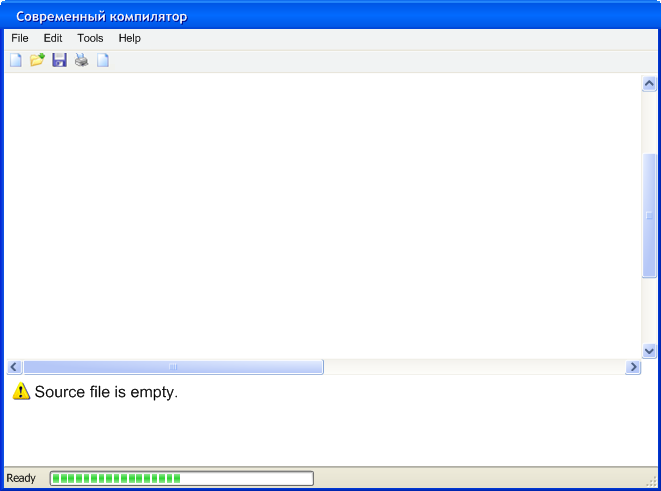
Initially the source file is empty (see the figure below), and the object model is empty in exactly the same way.
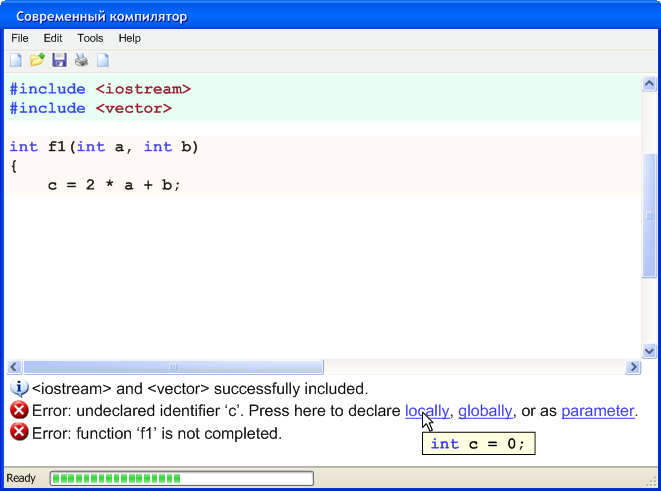
As you type the program text, the compiler analyzes the entered text in parallel threads, checks the syntax, and creates the necessary internal objects (see the figure below). For example, including header files is a completely self-contained fragment of the program, and the compiler immediately connects the necessary namespaces, identifiers, and so on. This is reflected in the console with the message “Libraries successfully included,” and the corresponding lines in the editor have a nice little green background — “everything’s ok.”
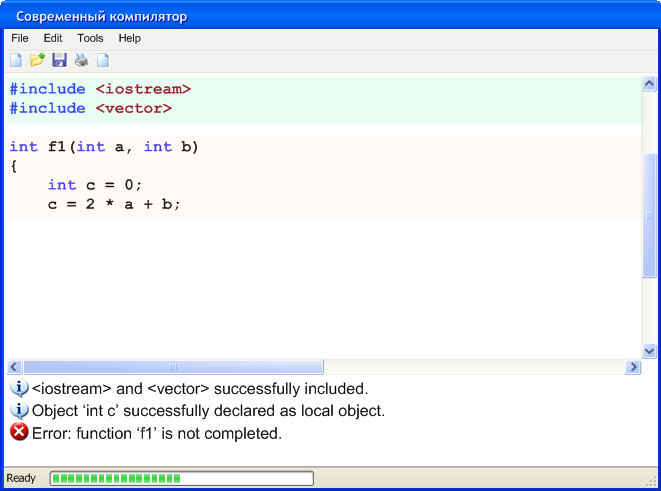
While code is being written, the compiler offers various hints. In this example, while the last line was being entered, the compiler encountered an unknown identifier. A message is immediately written to the console suggesting that this object be declared locally, globally, or as a parameter. The compiler also reports that the definition of function f1 has not yet been completed. The corresponding lines of code are highlighted in nice little red. The figure below shows the result of automatic object definition.
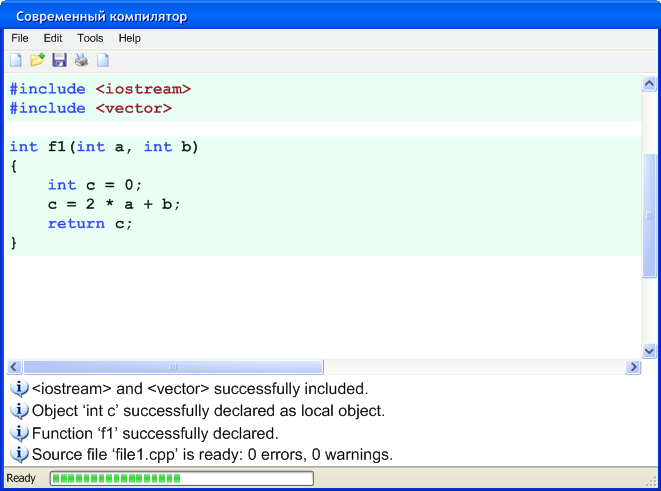
At the moment the last lines of the program were being written (see the figure below), the compiler determined that the current source file contains no errors and is complete. The console reports that the file contains no errors, as well as information that function f1 has been successfully defined.
Such a compiler does not need a “Compile” button, because syntax analysis, construction of internal objects, and generation of object code happen in background parallel threads. Since 2- and 4-core processors are so popular now, why not give programmers a present like this.
Answers to some questions.
Question: won’t this slow things down, won’t the hard drive be constantly chattering? Answer: if it is designed and implemented competently, it won’t. This is not about fully recompiling the entire file when the next character is entered, but about incremental compilation, where a block, a line, or even an expression of the source file is recompiled (or compiled further). These fragments are small enough to be processed in a matter of milliseconds.
Question: but what do I do if I’ve got an already finished project? Answer: when opening the project, start compiling it in the background, showing progress in the console.
Question: where can I download such a compiler or development environment? Answer: I don’t know of any such compilers. This is only an idea of what would be convenient from the user’s side. Such functionality is partially implemented in IntelliSence in Microsoft Visual Studio, where objects are analyzed on the fly and unknown identifiers are underlined.
Question: but if there’s no program, where did you make the screenshots? Answer: the screenshots were made in Visio 2007.
If there are any more questions in the comments, I’ll update the post and add the answers.