I recently finished reading Jiří Toman’s book “The Art of Speaking.” As the title makes clear, this book is about how to speak beautifully and competently. Communication is a very important skill. You need to communicate a lot and often: with family, with friends, with colleagues at work; some people have to give lectures, and some have to defend theses. And only a select few will get lucky enough to zombify the electorate from a high rostrum. So this topic ought to interest a wide range of readers. A couple of years ago I read a book by the well-known TV host Larry King on a similar subject, and I was very pleased with it. So Toman’s book also promised to be useful.
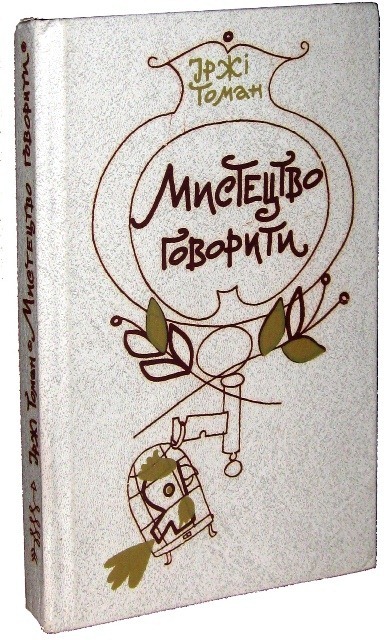
The book was published in Prague in 1981. It was translated into Ukrainian and published in Kyiv by the political literature publishing house in 1989. Which means the book was written back when many of us weren’t even born yet. You sit there and marvel: how is it that people knew all this ages ago, and I’ve only just now thought to read about it. In the Soviet Union they knew a thing or two about books.
The book has 293 pages, covering a broad range of questions: what communication is, the ethics of communication, working with your voice and hearing. How to choose the right words, phrases, and style. How to work on posture, gestures, and facial expressions. Holding meetings, how to persuade people, bring them around to your point of view. How to prepare talks, what should be in them, how to deliver a talk. “The Art of Speaking” has the quality of any sensible book: the density of information is simply off the charts. There are no long-winded reflections or repetitions. The author mercilessly exploits the very principle he preaches: “Use examples from personal experience,” and gives lots of examples from personal experience, which fires the reader up even more.
The book ends with a
All I know about Jiří Toman is that he is an ardent communist, a sociologist, and, judging by the context, a computer-engineering engineer, i.e., a colleague of ours. Toman also wrote a book called “How to Improve Yourself,” which should also be found and read, because it may turn out to be the same kind of napalm as “The Art of Speaking.” Ah, the communists wrote well!
I’ll separately tell how I got this book. As in any city, Kharkiv has a book market, the so-called “book ravine.” The market itself is a hotbed of counterfeit software and packs of toilet paper that, for some reason, have “Darya Dontsova” and “Paulo Coelho” written on them. And next to the market there is Klasychnyi Lane, where in the mornings citizens lay out various old and not-so-old books. One Saturday morning, after sorting out some business on Rymarska Street, I decided to spend the remaining time in that lane. It’s very hard to leave there empty-handed: there are lots of books, and if you haggle, you can get them cheap. That time I picked up two books on one subject: the collected works “On Oratory” and Toman’s “The Art of Speaking.” The second one cost me a ridiculous 8 hryvnias (one US dollar).
For the first time in my life I’m voluntarily reading a book in Ukrainian. By the way, I remembered why I don’t like fiction. I’d already had one attempt at voluntarily reading a Ukrainian book. About four years ago I deliberately bought Stephen King’s “Cell” (“Zona pokryttia”) in Ukrainian, to combine pleasure with usefulness: practice the language and read a good work of fiction. Surprisingly, the book by a big-name author turned out to be a drawn-out, dreary piece of shit, with a plot worthy only of the show “Battle of the Psychics,” though even that is sometimes more interesting. Somewhere around page eight I realized that “Cell” wouldn’t come within even a quarter of “The Shining,” and put the book on the shelf. If anyone needs it, I can give it away.
Separately, a few words about the quality of the book. The typesetting is good, but the paper, alas, has already yellowed. There are no illustrations in the text, but, actually, they aren’t really needed.
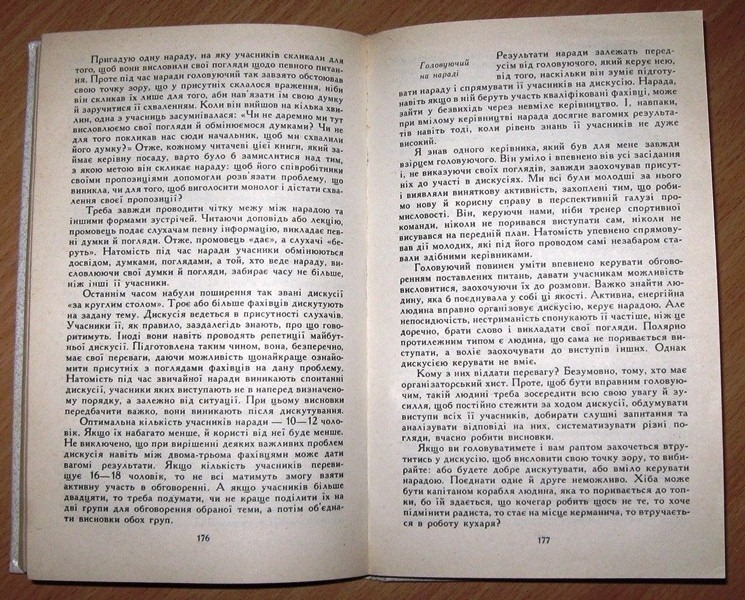
Jiří Toman’s “The Art of Speaking” is one of those books that, after reading, you think: “Damn, it ended so quickly.” You don’t want to put it away for long; you want to reread it again.
Verdict: strictly required reading.