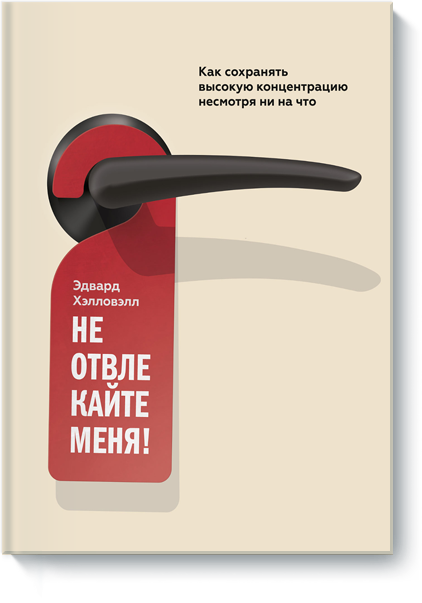
I recently finished reading “Don’t Distract Me!” by Edward Hallowell (120 UAH in electronic form).
Let me brag: I have good luck with books. As soon as something in life starts bothering me, a book on exactly that topic lands in my hands.
It all started with the voice in my head beginning to repeat: there’s little time, lots to do, need to get more things done in less time. For a while this voice just talked inside my head, but then it started looking for practical implementation.
For example, the voice would say: “Hey, why are you just sitting there? Oh, the project takes a long time to compile? Well then open your mail and write some emails! Or google the solution to that problem, you remember, the client complained a week ago. No, not yesterday, not yesterday, a whole week has passed, and you still haven’t helped the person, you heartless beast”!
Or the voice would say this: “Hey, doesn’t it seem to you that when you get to the office, putting the kettle on, then taking off your coat and making tea is more optimal than first taking off your coat, then putting the kettle on and doing nothing for a whole 2.5 minutes? Were you planning to live forever, the way you throw time around???” (Repost if you’ve done this too.)
Very often it would suggest: “Listen, how about you open 7 chats at once and answer everyone at once in the same amount of time”? (Like if you do this constantly.)
And the voice would often say this too: “Shhh... trouble, someone’s coming into the room! Close Facebook, open your mail, and pretend you’re very busy. And now tell this person that you’ll solve their problem someday on some other day, for example tomorrow!” (Like and share if this is about you too.)
This went on for several years. The 2.5 minutes won while boiling the kettle couldn’t compare in any way with days of getting nothing done. And sometimes weeks of getting nothing done.
In the book “Don’t Distract Me!” I read that this is situationally induced attention deficit. Most often it showed up as a constant desire to look at my mail — had anything important arrived? — or refresh social media — what if someone wrote something? In the end, instead of productive creative work, there were constant switches to everything else that doesn’t have much to do with work. On public transportation, where you can’t exactly pull out a computer, my smartphone replaced it for me. There I could check both mail and the little social networks. And since I have about 5 of them, by the time it comes to checking the fifth, you can already start going around the circle and checking the first one again — well, what if something new appeared? Life got stuck in a loop.
In the book, the author looks at various factors that affect concentration: the computer, multitasking mode, and a person’s morale, their thoughts, and their relationships with the people around them. Also, in the second part of the book he gives recommendations for how to improve concentration.
I don’t even know who I could possibly not recommend this book to. So I recommend this book to everyone.