I recently read the book “Reflections on Personal Development” by Ichak Adizes (325 UAH in paper form).
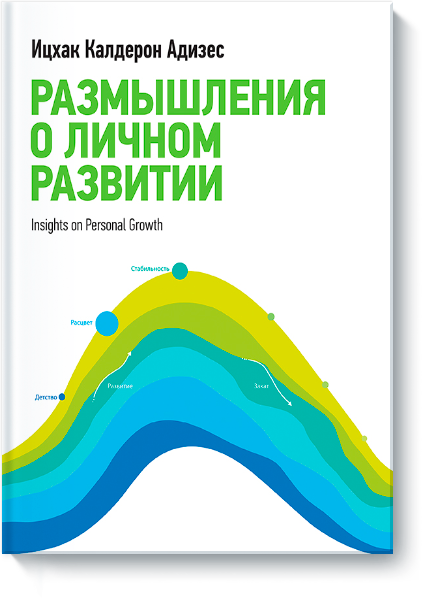
I had already read Adizes before. It was the book “How to Overcome Management Crises,” and I liked it a lot. My expectations for the next Adizes book were high. It turned out that “Reflections on Personal Development” is a collection of notes from his personal blog. That is, for 355 UAH I got a printout and translation of his notes, which I could have read completely free in the original at http://www.adizes.com/insights/
From the outside it may look like I screwed myself, but that’s not the case. I’ll explain now.
There are a lot of smart people in our world. Some of them openly voice and publish their thoughts. There’s no opportunity to talk personally with each of these smart people. But nothing is stopping you from reading books, blog posts, watching videos of these people’s talks, to get acquainted with them and learn their ideas.
What’s the difference between a book and a blog? A book is a stricter format. For example, in “How to Overcome Management Crises,” Adizes lays out his method, but not his personal attitude toward everything under the sun. A blog, on the other hand, is an informal format. In his blog he writes precisely his personal opinion on various questions: about business, about life, about success, and even about the fate of Jews in the Holocaust. I’ll emphasize it once again: the author’s personality, the author’s method, and the author’s personal attitude are three different things.
Besides, publishing blog posts as a separate book is both a chance to make money (the blog can be read for free, while the book has to be bought) and a chance to hook an audience that doesn’t hang out online.
And also, to write a book, you have to sit down and write it. A blog can be kept from anywhere — from home, from trips; you can write a post in 5 minutes, or you can take 3 hours. And then, lo and behold, 20 years later you can put together a book.
As for the book itself, I was interested in getting acquainted with the author’s personal opinion, although of course I expected something close to a method of personal development (because the method in “How to Overcome Management Crises” is set out in detail).
If you’re going to buy books, read the annotation and introduction on the site: is this, by any chance, a reprint from a blog? It may seem like a rare case, but it isn’t. For example: Artemy Lebedev’s blog has been published as a book: “My Blog, O Lord,” notes from the blog of Dmitry Yuryevich Puchkov (Goblin) have repeatedly been published as books: http://www.ozon.ru/person/270747/?group=div_book#detf
As a summary: there is no method of personal development in the book. But if you’re interested in getting to know Adizes better, you can read the book without hesitation. The translation and design of the book are good, but again, all of it can be read for free at the primary source: http://www.adizes.com/insights/