The other day I read Ichak Adizes’s book “How to Overcome the Crises of Management” (420 UAH at the business literature store). As a result of reading it, I clarified for myself what kinds of managers and executives there are.
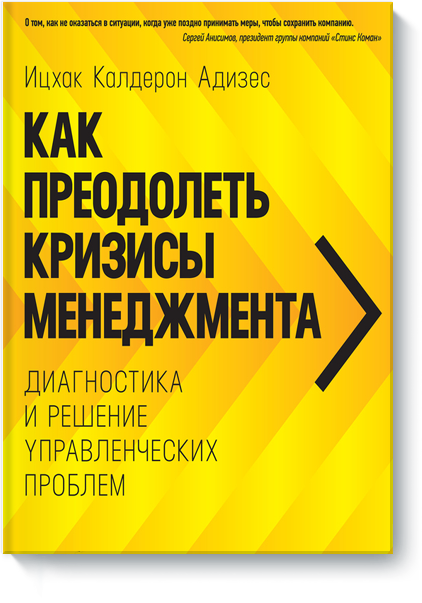
The author identifies four components:
P — performance qualities, the ability to work painstakingly and see things through to the end;
A — administrative qualities, the ability to maintain an “everything by the book” mode of operation;
E — entrepreneurial qualities, the ability to see new opportunities, generate new ideas;
I — integrative qualities, the ability to come to terms with others, bring a team together.
And every person, including an executive, combines these qualities in himself to some degree. According to Adizes, a strongly expressed quality is encoded with a capital letter; a weakly expressed one is encoded with a lowercase letter. The absence of a quality is encoded with a zero. Thus, PAEI is the ideal executive who combines all the qualities. The book says there are no such people. 0000 is a “dead stump,” an executive completely incapable of anything.
Typical “characters” of executives are given.
For example, 00E0 is the “arsonist,” according to Adizes. An executive who gushes ideas, and every week he has new ones. Each subsequent idea is better than the previous one, in his opinion. The subordinates of such an executive suffer, because they haven’t had time to finish the previous assignments before they already have to drop everything and do the new idea.
0A00 is the “bureaucrat,” according to Adizes. With an executive like that, there’s no point dreaming of any development, but everyone does have to arrive at exactly 9:00, leave at 18:00, sit through monotonous meetings, and write reports in a strictly defined format.
Or, for example, P0E0 is the “scientist who was appointed director of an institute” or the “actor, head of a theater.” He knows how to work, sees new opportunities, but has no idea how to manage and can’t bring a team together.
And so on.
While I was reading the book, several times the thought occurred to me: “How does the author know all my shortcomings and describe me so accurately”? Besides that, I applied all the knowledge to all my current and former bosses: it all checked out. The secret is that over the course of his practice, Adizes has analyzed the work of hundreds of companies. He knows what he’s talking about.
Adizes says that a company’s success is a well-selected team of executives in which everyone contributes within his area of competence and all of whom are united by the I quality — the ability to come to terms. Besides that, it’s important to have weakly expressed qualities not only in your own competence, so as to better understand the other members of the team.
I recommend the book to everyone: managers, programmers, deans, department heads, rectors, directors, vice rectors, injectors. You sharply begin to understand your place in the organization, your strengths and weaknesses. The path is visible for how to achieve success together.