“If I have seen further than others, it is because I stood on the shoulders of giants” Isaac Newton
After the research topic for an article (see “On Choosing a Topic for a Research Paper”) or for a term paper, thesis, or dissertation has been defined, you need to work very closely with the sources.
By a source I mean: a blog post, a page on a website, a research article in a journal or collection, already defended term papers, theses, dissertations, monographs, books, public talks.
Why do you need to do this?
-
In any case, by reading the literature you’ll get smarter and learn something. It’s unlikely you’ve undertaken to write on some topic you know inside and out. Well, let’s not kid ourselves: even when working on something well known, you have to peek into handbooks and other sources to double-check facts or quote something.
-
In most formats (article, term paper, thesis, dissertation), a literature review section is mandatory. Usually this list is checked so that there are no “Murzilkas” in it (sources that have nothing to do with the topic of the work). A simple piece of work like a term paper should rely on
5–10 sources. For dissertations, that bar is raised to100–200 sources. -
Studying the literature will keep you from ending up in a stupid situation where your seemingly unique and brilliant idea was already described in detail by someone about twenty years ago. Studying the literature lets you confirm scientific novelty.
Show some respect for your academic advisor and the scientific community. Use your capacity for self-education before asking questions or publishing your results.
Before you start working with sources, you need to find them. You should start searching with general formulations. For example, if you’re writing about hardware synthesis, that’s exactly the query you make: “hardware synthesis.” As you go deeper, the wording will become more complex, for example: “a method for interface synthesis from C++ description.”
Where should you start searching? The easiest way, of course, is to do it sitting at home in front of the computer. Libraries and search engines for (mostly) English-language articles:
-
IEEE Computer Society Digital Library (paid) — periodicals and archives of conferences held under the umbrella of the IEEE Computer Society. There are several dozen publications and several hundred conferences. Student (graduate student) membership in IEEE, Computer Society, and access to the digital library may together cost around $100 a year. But when conducting research, that money will save you time searching for the articles you need.
-
ACM Digital Library (paid) — periodicals and archives of conferences held under the umbrella of ACM. Registration + library access will also cost around $100.
-
CiteSeer (free) — in fact, this is not a library, but a kind of “Google” for articles. The search crawler scans the internet for freely available article texts. It remembers the title, authors, and links to other articles. The PDF file itself is cached on the server.
-
Google Scholar (free) — also a search engine; it scans many sources (including the ones mentioned) and shows both paid collections and free ones.
-
arxiv.org (free) — yet another search engine for articles.
-
Various publishers that provide free access to their periodicals, for example, http://www.hindawi.com/journals/
Unfortunately, I don’t know of any decent Russian-language search engines or collections. I’d be grateful if blog readers pointed them out in the comments.
Don’t neglect ordinary libraries. At one point I tried to find, on the internets, a book published in the USSR in the
All the articles you obtain need to be organized on the computer in some uniform way. The bibliographic reference should be entered into a special Word file. Articles can be put into separate little folders by topic or by author.
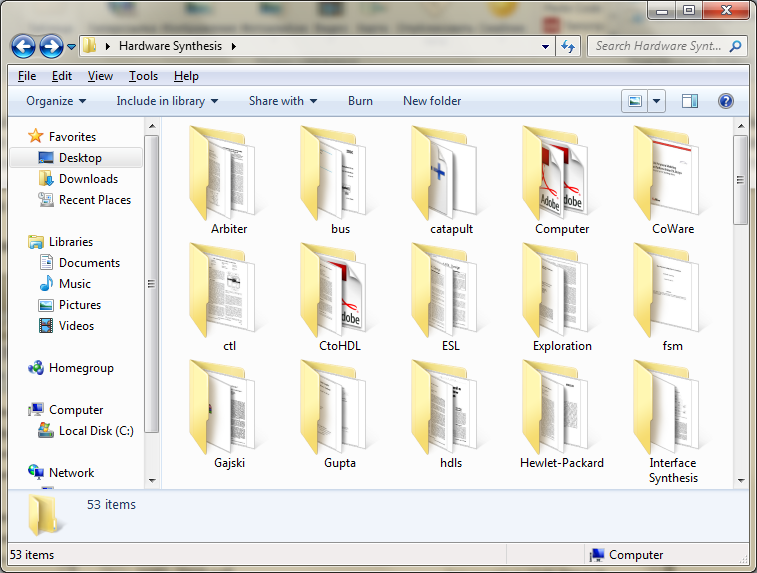
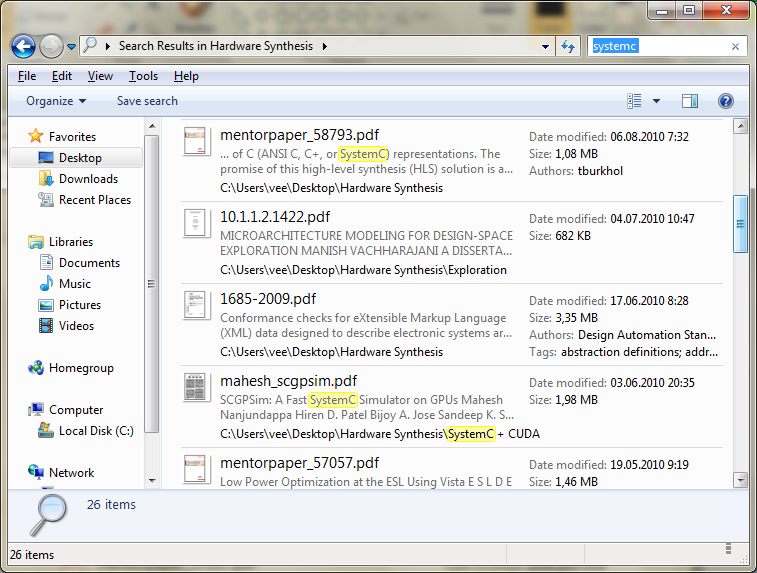
And if that little folder is also indexed, it will be much more convenient. Sooner or later, a lot of documents will pile up, and keyword search will be very handy.
It may happen that a simple internet search will turn up an insufficient number of articles. That’s no problem at all. Now we’ll just use another search method.
1. Searching by references
Because it is considered necessary to cite other sources, all articles are in the kind of relationship shown in the figure:
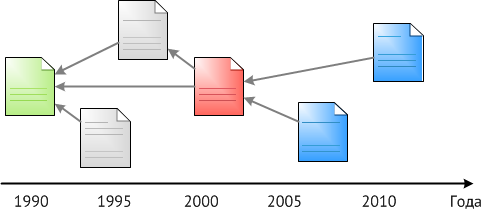
Here the red article is the article you found, for example, through Google. Usually at the end of every article there is a section called “References” or “Sources.” In this example, the red article cites one gray and one green article. If the author of the red one cited them, there is a very high probability that those articles are also related to the research topic. Which means you must definitely find those articles, study them, and then incorporate them into your work. Pay attention to the green article. It is old, and it has as many as three citations. It is probably some foundational work that describes the basics or first defines one problem or another. Most likely you won’t find the solution to your specific problem in it, but it may prove quite useful for understanding the overall picture and the history of the issue. This is what a typical references section looks like:
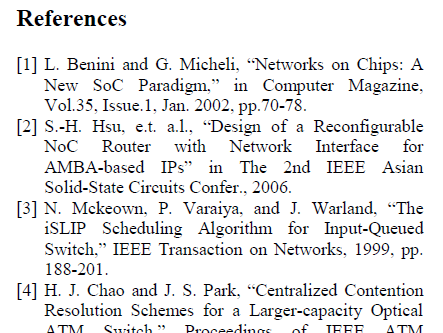
Be sure to find those little squares with numbers in the text of the article. Then you’ll be able to understand where the author cited the source. This will help you understand the context.
Things are a little more difficult with the blue articles. These are the articles that cite the red one. The problem is that at the time of publication, the author cannot know who will cite this article in the future. But usually sites with article archives build these lists themselves during indexing. If you see that someone has cited an article on the topic you’re interested in, you can safely take a look at that work. It is quite likely that it proposes a new solution or a development of the idea. You can also find out who cited the current article through Google. Just copy the article title and paste it into the search engine in quotation marks.
2. Searching by author
You found an article and it seemed interesting to you. Look at who the author of this article is. Usually, over the course of a year or several years, an author publishes several articles in which they consistently develop one topic or several related topics.

By entering the author’s full name in Google, you can find his home page, where all his works from recent years will be listed. And there may also be direct links there to PDF files with the text. Great success! Again, besides Google, sites with article archives that can filter by author will help you.
3. Searching by collection or journal
You should also pay attention to the publication (periodical journal or collection of articles) in which a given article was found. It is quite logical that all conferences have a single theme. Therefore, by googling (or filtering on the article site) by the conference name, you can find articles similar to the one you have already found by other means. And if you stumble onto the archive of some conference on your topic — then that’s easy street!
And in conclusion I want to remind you about Lenin’s curve (learning curve).
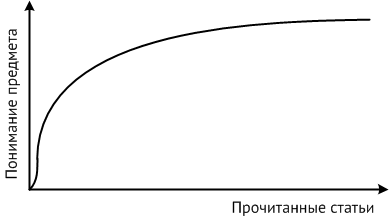
Sooner or later, after reading the
Yes, and let’s not be lazy. We still have to raise domestic science from its knees after the democrats, together with the effective managers, made such a mess of things.
See also