Students are curious:
Volodymyr Ihorovych, why do we need to write these hateful term papers?
A bit of background. A commission at KhNURE found plagiarism in the reports for term projects by a number of students. The meaning of the word “plagiarism” is the deliberate appropriation of authorship of someone else’s work of science or art, or of an invention [Wiktionary].
Five years ago I already wrote about plagiarism: “Plagiarism at a university”. In the civilized world, when plagiarism is found, an instructor has the right to: make the student redo the work, give an F for the work, give an F for the course. In the case of plagiarism in a term project, the recommendation is to give an F for the course. For repeated plagiarism in the civilized world, the student gets a jumping kick in the ass, and with a running start, too.
But the question is something else. Students understand that stealing is bad. They don’t understand why, for a term project, it’s not enough just to write a computer program and defend it. Why do you also have to write an explanatory report?
The motivation “because the explanatory report teaches the student to formulate their thoughts” obviously doesn’t motivate anyone anymore. Here you have to explain what the benefit is of being able to formulate your thoughts. Let’s consider a graph model of a small organization, where the vertices are employees and the edges are communications between them (assigning tasks and reporting on completion):
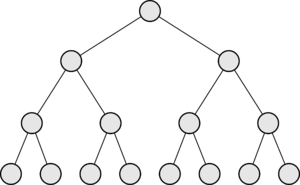
In other words, at the bottom level are rank-and-file employees, a bit higher up are supervisors and middle managers, and at the top is the director. In such an organization, the role of communication increases from the bottom up. A rank-and-file employee has a very small area of responsibility and practically no freedom to make decisions. Everything he needs to do has already been decided and planned by his supervisor. At the very top level, though, is the director, who bears full responsibility for the entire organization. Any manager spends 70% or more of his time communicating with people lower and higher in the hierarchy.
Formulating and conveying your thoughts competently is an important function of any manager.
Can’t competently document a system architecture? You’ll never become a lead programmer, and no one will trust you with subordinates. After all, you’re not capable of assigning a task and explaining it to another person.
Can’t competently draw up work plans and report to higher-ups? No one will ever trust you to run a project.
Can’t competently put together a business plan and convince investors your startup will succeed? No one will ever trust you with even a hundred bucks.
Can’t formulate and convey your thoughts? Stay a simple doer at the bottom of the organization’s hierarchy, with the corresponding level of responsibility and a proportional level of pay.
In previous installments:
— Students are curious about the reality of expulsion.
— Schoolchildren are curious about whether fiction is needed.
— Students are curious about choosing a major.
— Students are curious about completing a course after the deadline.
— Students are curious about choosing a programming language.
— Students are curious about submitting a diploma project.
Interested in my opinion on any question of university life? Send your questions to volodymyr.obrizan@gmail.com. Anonymity is guaranteed. Answers will be published as questions come in. Questions can also be asked through the anonymous-questions site http://ask.fm/obrizan